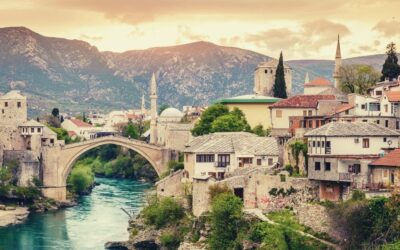
The road north-west out of Sarajevo turns into something else around Visoko. The valley opens up, the Bosna river starts running parallel to the highway, and you remember Bosnia is not just Sarajevo and Mostar. Two and a half hours later you’re standing in Travnik, the old Ottoman vizier capital, and an hour after that you’re in Jajce, looking at a 22-metre waterfall that drops in the middle of the town.
This is a route we drive often, second only to the Sarajevo-Mostar corridor. Below is the day trip we’d suggest, the stops in the order our drivers take them, and the practical things you should know before you go. Important: this is a suggested itinerary, not a packaged tour. We’re a private transport company. What we offer is a vehicle with an English-speaking driver for the day. The route below is one we know works because guests book it most often. You can change anything: skip a stop, stay longer, swap the order. You can also use this guide if you’re driving yourself or going by bus. We just put it together because guests kept asking what they should do once they get to Travnik or Jajce.
Why head this way at all
Most first-time visitors to Sarajevo go south to Mostar. That’s the famous trip. The north-western day, towards Travnik and Jajce, is the one experienced travellers ask about on the second visit, or the ones who already saw Mostar and want a quieter day with fewer tour buses.
What’s actually here:
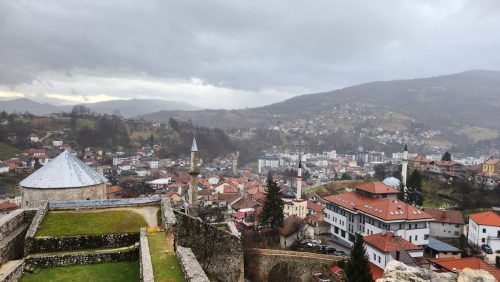
- Travnik: the Ottoman vizier capital from 1697 to 1850. Hilltop fortress, the famous Šarena (Coloured) Mosque, and ćevapi that locals will fight you over (they say it’s the best in Bosnia, and they may be right).
- Jajce: the medieval Bosnian royal capital. A 22-metre waterfall in the centre of town where the Pliva drops into the Vrbas. A walled fortress on the hill above. Catacombs cut into the rock from the 14th century.
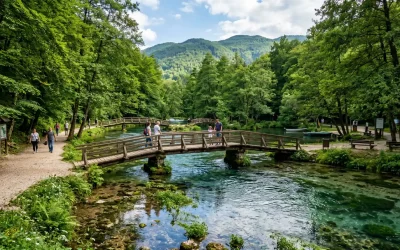
- Pliva Lakes and the Mlinčići watermills: 5-6 km west of Jajce. Twenty wooden watermills standing on the river between two lakes, looking like a fairy-tale village.
The drive is 175 km one way (Sarajevo to Jajce, via Travnik). It’s a long day. But everything is genuinely worth a stop.
Travnik
The day we’d suggest
This is what we’d plan for guests who want to see all three places without rushing. Pickup time can move earlier or later. Our drivers are happy to start at 6:30 if you’re a morning person, or 8:30 if you’re not.
07:30 — Pickup in Sarajevo
From your hotel, an apartment, or the airport. The drive to Travnik is about 1 hour 45 minutes on the M-5, through the Lašva valley. It’s a good road. The first 30 minutes climb out of Sarajevo, then it flattens through small towns.
09:15 — Travnik (about 2 hours)
Park near the centre, walk up to the fortress (Stari grad). The climb is 10-15 minutes on a paved path, no big effort. Entrance to the fortress is around 3-5 KM (€1.50-2.50) and the views from the walls cover the whole valley. There’s a small museum inside the round tower with local history. If you’d rather have Travnik as a focused half-day on its own, our direct Sarajevo to Travnik transfer works as a one-way or return without the Jajce leg.
Walk back down to the Šarena (Coloured) Mosque, the most striking mosque in Bosnia and arguably the prettiest in the Balkans. The exterior paintwork is unique — flowers, arabesques, geometric patterns from the 18th century. Free to enter outside prayer times. The mosque has a rare feature: a covered bazaar built into its base, one of very few mosque-bazaar combinations still in use in the Islamic world.
Walk five minutes to Plava Voda (Blue Water), the cold spring that runs through the lower town with cafes built right above the water. This is where you stop for coffee, or for an early lunch.
If you want ćevapi: the local debate is between Hari’s in Donja čaršija (most famous) and Karajlić right next to the central mosque. Travnik ćevapi are smaller and spicier than Sarajevo’s, served in a thinner, crisper somun bread. Travnik ćevapi people will tell you with a straight face that Sarajevo ćevapi are tourist food. Sarajevo people will say the opposite. Try both, decide for yourself.
If you want coffee with a story: Lutvina Kahva, mentioned in Ivo Andrić’s Travnik Chronicle, sits at the foot of the fortress where Plava Voda runs. The “Lutvina coffee” comes with matches printed with the cafe and a Drina cigarette. It is touristy now, but the location is genuinely beautiful and the coffee is fine.
11:30 — Drive to Jajce (about 1 hour 15 minutes)
Continuing west on the M-5, then M-16. The road follows the Vrbas river canyon for the last 30 km, which is a scenic drive. By the time you arrive in Jajce, it’s about 12:45.
13:00 — Lunch at Pliva Lakes (60-90 minutes)
We suggest stopping at the lakes first, before going into Jajce town. The lakeside restaurants do trout and lamb at lower prices than Jajce centre, the views are open across the water, and the Mlinčići watermills are right next door so you walk to them straight after lunch.
The Mlinčići watermills are 5-6 km west of Jajce on the river that runs between the two Pliva Lakes. About 20 wooden watermills, some 300+ years old, sit on stilts over the water in two rows connected by wooden planks. Free entry, parking around 1 KM/hour. The interiors aren’t open to walk through, but the exterior view from the wooden walkways is what you came for. Plan 30-45 minutes here, more if you want to swim or rent a kayak in summer.
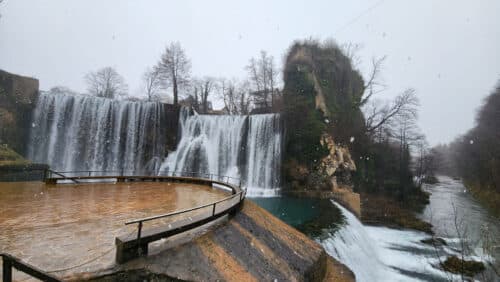
Jajce waterfalls, photo by Sarajevo Transfer
15:00 — Jajce town (2-3 hours)
Park near the centre. The town is compact and walkable. The driver waits, you explore.
The waterfall (Pliva Waterfall): 22 metres high, falling right where the Pliva meets the Vrbas in the middle of town. There’s a paid viewing platform that gets you down to pool level — ticket prices have moved around recently, in the 8-10 KM range, so check at the booth. The free view from the green pedestrian bridge across the valley is genuinely just as good — you see the waterfall, the medieval town, and the fortress all in one frame.
The fortress: a 13th-century Bosnian royal capital, the last stronghold of the Bosnian kingdom before it fell to the Ottomans in 1527. About 5 KM entrance, 15-20 minutes to walk up from the lower town. Inside the walls there’s not much standing besides the round tower and the ramparts, but the panorama ranks with the best in central Bosnia.
The catacombs: a 14th-century underground crypt cut into rock, located inside the fortress walls. Around 5 KM separate ticket. Brief but unusual — small chambers, an altar, faint carvings on the walls.
Šarena Sultanija Mosque: 18th-century, said to be the only mosque in Europe named after a woman (Esma Sultanija, the wife of an Ottoman vizier).
If you’ve still got energy, the AVNOJ Museum nearby covers the founding of socialist Yugoslavia at the 1943 conference held in Jajce. Worth a stop for anyone interested in 20th-century Balkan history.
17:30 — Drive back to Sarajevo (2.5 hours, with one short stop)
Back the same way. Most guests doze for the first hour and watch the sun set over the valley for the second. We’re back in Sarajevo by 20:00 or 20:30.

Mlinčići Pliva Lake
What to skip if you’re tight on time
If you only have 8-9 hours instead of a full day, the cuts we’d make:
- Skip the Travnik fortress climb if it’s hot or raining. Šarena Mosque + Plava Voda + lunch is enough to get the feel of Travnik without the extra hour.
- Skip the Jajce catacombs. Brief, niche, and the fortress climb covers the same period of history.
- Skip Pliva Lakes if you’d rather have an extra hour in Jajce town. The waterfall and the fortress are the bigger draw.
What we wouldn’t skip: the Šarena Mosque in Travnik, the Mlinčići watermills, and the Jajce waterfall view from the green bridge. Those three are the photos you’ll want.
Why book a private driver instead of going alone
Honest version: you can absolutely do this day trip yourself. Rent a car in Sarajevo, drive the M-5, park where everyone else parks. Or take the public bus to Jajce (3-4 hours, around 18-20 KM one way) and skip Travnik. We won’t pretend that’s not a real option.
What a private driver gets you:
- No driving on a long, winding road. The last 30 km into Jajce follows a canyon. It’s not dangerous, but it’s a constant series of curves with locals overtaking aggressively. After ten hours of driving and sightseeing, having someone else at the wheel for the trip back is the part most guests appreciate most.
- Door-to-door pickup and drop-off. Including from the apartment in the Old Town that has no car access — the driver waits at the nearest curb.
- Flexibility on the day. If you spend an extra hour at Plava Voda having coffee, the schedule moves with you. No bus you’ll miss, no parking ticket.
- Multiple stops in one day. Bus routes don’t combine Travnik and Jajce in a way that gives you usable time at each.
- Local context. Our drivers have done this route hundreds of times. They can tell you which restaurant in Travnik has the queue today and which one is empty for a reason. They aren’t tour guides — they don’t walk around with you on commentary — but they answer questions on the drive.
It costs more than the bus. It’s about the same as the rental car if you split the day with three or four people, and you don’t have the driving stress. To see what this works out to for your group, request a fixed quote with your dates and pickup location.
What’s included with the vehicle, and what isn’t
A few things to be clear about, since “tour” can mean different things to different people.
What we include:
- The vehicle for the day (sedan, van, or minibus depending on group size)
- An English-speaking driver
- Fuel, tolls, parking
- Pickup and drop-off at your accommodation in Sarajevo
- Flexibility to change the route or stops on the day
What we don’t include:
- Entrance fees (Travnik fortress, Jajce fortress, Jajce waterfall platform, catacombs — total around 20-30 KM per person if you do everything)
- Lunch and drinks
- A licensed tour guide. We’re a transport company, not a tour agency — the driver is a driver, not a guide. If you want a licensed guide who walks you through Travnik or Jajce, we can arrange that for an extra fee, or you can hire one independently at the destination.
If you’ve researched something on your own — a specific restaurant, a viewpoint we haven’t mentioned, a stop we don’t usually make — bring it up. We’ll happily take you there. The route above is just our default suggestion.
When to go
- May, June, September, early October are the sweet spot. Mild weather, full daylight, the lakes look their best. Mlinčići in May is genuinely a postcard.
- July and August are fine but hot. The Travnik fortress climb gets uncomfortable around 33-35°C in midday. Start earlier.
- November to March is when the route changes character. Snow makes the canyon section slower, but the waterfalls run heavier and the Mlinčići scene with snow on the wooden roofs is striking. Some mountain restaurants close.
- April is unpredictable — could be the best or could be three days of rain.
For pricing and booking
Day rates depend on group size, vehicle type, and exact pickup point. To request a fixed quote, send us your dates, number of travellers, and any stops you’d like to add or skip. The booking form on the Sarajevo Transfer homepage covers most options.
If you’d rather skip Travnik and go straight there, our direct Sarajevo to Jajce private transfer is the simpler one-way option, and Travnik works the same way as a half-day via our Sarajevo to Travnik transfer. Some guests use Jajce as a midway stop on a longer route — the natural continuation north-west is the Sarajevo to Banja Luka transfer with Jajce as a planned stop on the way.
If you’re planning multiple days in the country, this Travnik–Jajce route fits well alongside the more famous southbound day. We have a separate suggested itinerary on our Sarajevo to Mostar private tour, and if you’ve already done that one, the Sarajevo local day tour covers Vrelo Bosne, the Tunnel of Hope, and Jahorina. Our Bosnia private tours page has all the routes we drive together.
Frequently asked questions
How long is the day trip from Sarajevo to Jajce and Travnik?
Roughly 11-12 hours door to door. The drive is about 5 hours total (2.5 each way), and you spend 6-7 hours actually visiting the towns and the lakes. We’d suggest a 7:30 pickup and a 19:30-20:30 return.
Can we do just Jajce, or just Travnik?
Yes. Just Jajce is a 9-hour day with more time at the waterfall, the fortress, and the lakes. Just Travnik is a half-day, around 6 hours, which we sometimes combine with a stop at Visoko (the so-called pyramids) on the way back.
Is the drive difficult or scenic?
It’s scenic, especially the Vrbas canyon section near Jajce. Not difficult to drive, but constant curves on the last 30 km, and aggressive local overtaking is normal. Most guests prefer not to drive themselves on the way back.
What’s the difference between Travnik ćevapi and Sarajevo ćevapi?
Travnik ćevapi are smaller, spicier, and served in a thinner, crispier somun. Sarajevo ćevapi are larger, milder, served in a fluffier somun with chopped onion. Travnik people consider theirs the original. Sarajevo people consider theirs better. The actual answer is they are both excellent and you should try both.
Are the watermills at Mlinčići worth the detour?
Yes, especially in spring and summer when the water is high. They’re 5-6 km from Jajce centre, free to enter, and the location between the two lakes is genuinely pretty. Plan 30-45 minutes.
Is the Jajce waterfall free to see?
The waterfall itself is visible from public spots in the town for free, and the best free viewpoint is the green pedestrian bridge across the valley. The paid platform takes you to pool level, around 8-10 KM, but most guests are happy with the free view.
Do you provide a guide as well as a driver?
The driver isn’t a licensed tour guide. They drive, they answer practical questions, and they know the route well, but they don’t walk you through Travnik or Jajce on a commentary. If you want a guide for a specific town, we can arrange one for an extra fee or you can hire one at the destination. Most guests on this route are happy exploring at their own pace.
Can we change the itinerary on the day?
Yes. The route above is what we suggest. If you want to skip Travnik, add a stop at Visoko, stay longer at the lakes, or have lunch at a specific place you’ve researched, just tell the driver. We’re a hire-with-driver service, not a fixed tour.